
Fustel de Coulanges in the Far North

The following is a (slightly revised) republishing of an older essay written in younger days, October 2023.
In The Ancient City (La cité antique), published in 1864, Fustel de Coulanges argues that ancient Greek and Roman societies were fundamentally influenced by their religious beliefs, in particular the cult of ancestors and household gods, and that the evolution of these religious practices explains the formation, revolutions and decline of their social and political institutions.
The author opens with an account of the most ancient beliefs.
D’après les plus vieilles croyances des Italiens et des Grecs, ce n’était pas dans un monde étranger à celui-ci que l’âme allait passer sa seconde existence ; elle restait tout près des hommes et continuait à vivre sous la terre. (de Coulanges, 1864)
A web translator is quick to translate into English.
According to the oldest beliefs of the Italians and Greeks, it was not in a world alien to this one that the soul would spend its second existence; it remained very close to men and continued to live beneath the earth.
We convert the same into Norwegian Bokmål.
Ifølge de eldste troene til italienere og grekere, var det ikke i en fremmed verden at sjelen skulle tilbringe sitt andre liv; den forble svært nær mennesker og fortsatte å leve under jorden.
We’ll repeatedly do so in the following, as we aim at training our reading in Norwegian. Machine translation will open the door to a few didactic experiments.
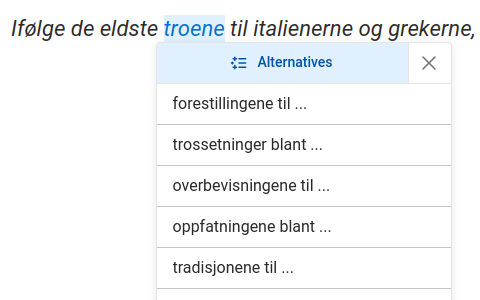
We’ll indeed leverage a consequential feature offered by good online translators, namely the opportunity to query, at each position in the sentence, alternative translations from that position onward. For instance, from the original translation above
Ifølge de eldste troene til italienere og grekere…
a click on troene proposes other options for the word at that position (of which the first is forestillingene) and reconstructs the remainder of the sentence accordingly (in our case, the substitution doesn’t call for any change down the line):
Ifølge de eldste forestillingene til italienere og grekere…
(Our intent is not to pit one web translator against the others, particularly since the capabilities of each are ever evolving: what’s important is their featuring, in one form or another, the option we are interested in.)
Let’s investigate a few alternatives. We highlight the variations in bold.
→ Ifølge de eldste forestillingene til italienerne og grekerne var det ikke i en annen verden enn denne at sjelen tilbrakte sin andre eksistens; den holdt seg svært nær menneskene og levde videre under jorden.
→ Ifølge italienernes og grekernes eldste oppfatninger var det ikke i en annen verden enn denne at sjelen skulle tilbringe sin andre tilværelse; den forble tett på menneskene og bodde fortsatt under jorden.
Tirelessly, we go back to the original text (English or French), marshal our abilities to the fullest, and try on a blank page to recover the Norwegian translation. Perhaps we feed the Norwegian attempt into the translator and see if it restores the original meaning. We play around with alternative translations, translate back and forth, then try hard on a blank page again.
As we’ll illustrate in the following, such manipulations of variants provide the perfect opportunity for a few didactic digressions, for forays into vocabulary and grammar. In a section on Revolutions, Fustel de Coulanges studies the concomitance and reciprocal influence of the decline in religious beliefs and major social changes.
Ce qui est certain, c’est que, dès le septième siècle avant notre ère, cette organisation sociale était discutée et attaquée presque partout. […] Les causes qui l’ont fait périr peuvent se réduire à deux. L’une est le changement qui s’est opéré à la longue dans les idées par suite du développement naturel de l’esprit humain, et qui, en effaçant les antiques croyances, a fait crouler en même temps l’édifice social que ces croyances avaient élevé et pouvaient seules soutenir. L’autre est l’existence d’une classe d’hommes qui se trouvait placée en dehors de cette organisation de la cité, qui en souffrait, qui avait intérêt à la détruire et qui lui fît la guerre sans relâche.
What is certain is that, from the seventh century BC onward, this social organization was under discussion and attack almost everywhere. [...] The reasons for its decline can be narrowed down to two. One is the gradual shift in ideas over time, resulting from the natural development of the human mind. This shift, by erasing ancient beliefs, also brought down the societal structure that these beliefs had constructed and could alone sustain. The other reason is the existence of a class of individuals who found themselves outside the city’s organization, suffered because of it, had an interest in its destruction, and waged relentless war against it.
We get it translated into Norwegian little by little.
Det som er sikkert, er at fra og med det sjuende århundret f.Kr. ble denne sosiale organisasjonen diskutert og angrepet nesten overalt.
A first alternative emerges:
Hva er sikkert, er at fra det syvende århundret f.Kr. og fremover ble denne sosiale organisasjonen utfordet og bestridt nærmest fra alle kanter.
Hva er sikkert transforms into det som er sikkert. The latter is a close approximation of the English, what is certain, while the former is quite the calque transcription of the original French, ce qui est certain, (*that, which is certain).
Fra og med (det sjuende århundret) becomes fra (det sjuende århundret) og fremover. Literally, the former means from and including (the seventh century), while the latter directly transcribes from (the seventh century) (and) onward, or from (the seventh century) going forward.
Ut-fordet is close in form to the German heraus-gefordert, challenged. Bestridt is a good approximation of was under attack, close to the German bestritten, and a descendant of the Old Norse word stríða (struggle, strive, fight). (Going through languages that are closer to our language of interest than is the original is perfectly sensible.)
Fra alle kanter finds its literal English equivalent in from all sides, while overalt seems closer to everywhere.
Årsakene til dens tilbakegang kan begrenses til to. Den ene er det gradvise skiftet i ideer over tid, som følge av den naturlige utviklingen av menneskesinnet. Ved å fjerne eldgamle trosforestillinger førte dette skiftet også til at samfunnsstrukturen som disse forestillingene hadde bygget opp og alene kunne opprettholde, falt.
There is plenty of room here for lexical experimentation, but we’ll indulge in a few grammatical observations first.
Dens in til dens tilbakegang is a non-reflexive possessive pronoun, that is, one that does not refer to (that is, whose possessor is not) the grammatical subject of the sentence. What is referred to is denne sosiale organisasjonen (this social organization) from the previous sentence. In contrast, the reflexive possessive pronoun in Norwegian is sin, sitt, sine. Let’s compare:
Han ser på hunden sin. (He looks at his [own] dog.) → sin refers to han, the subject of the sentence.
Han ser på hunden dens. (He looks at his/her (someone else’s) dog.) → dens refers to a third entity.Ved å fjerne translates by erasing, and we note ved + infinitive for the adverbial participial phrase (by + gerund-participle).
Observing how things translate instills grammar in us: a few data points might not be enough to extrapolate ironclad rules, but they certainly make us familiar with the patterns. Let’s turn to lexical observations.
Kan begrenses is a good rendering of can be narrowed down, but we can also say kan reduseres, or replace the whole of kan begrenses til to with går i hovedsak ut på to ting.
Den gradvise endringen i ideer gjennom tidene is an interesting variant of det gradvise skiftet i ideer over tid. The change takes place in (preposition i) the realm of ideas. Endringen or skiftet av ideer would have a slightly different, more situational meaning: a change of ideas (from one specific idea to another, in a specific individual or group).
Førte til at ... falt paraphrases and departs from the causative form of both the English (this shift brought down) and the original French (le changement a fait crouler), which would be rendered more literally by fått til å bryte sammen:
… har dette skiftet også fått samfunnsstrukturen …, til å bryte sammen.
Få + direct object + til + infinitive seems a good rendering of the causative make/have something/someone do/become something. Other good substitutes for å bryte sammen, for a faithful rendering of crouler (that is, falling while destroying oneself) could be å gå til grunne or å falle.Eldgamle refers to very ancient times, but not necessarily to (Greek or Roman) antiquity. The French word antique (les antiques croyances) has both connotations, a first meaning (I. A.1.) referring to a very ancient period, as in
Notre bourgeoisie actuelle, née en si peu de temps de la Révolution, n’a pas rencontré, en montant, de nobles sur sa tête. Elle a voulu d’autant plus être une classe tout d’abord. Elle s’est fixée en naissant, et, si bien, qu’elle a cru naïvement pouvoir tirer de son sein une aristocratie; autant vaut dire, improviser une antiquité. Cette création s’est trouvée, comme on pouvait prévoir, non antique, mais vieille et caduque. (Michelet, 1846)
and a second (I. A. 2) referring directly to the Greco-Roman legacy which Fustel de Coulanges portrays. The adjective antikk in Norwegian is therefore perhaps better suited. Furthermore, there are several candidates for beliefs: trosforestillinger, troer or oppfattinger convey slightly different nuances. Trosforestillinger might rather refer to specific, structured beliefs, usually of a religious or mythological nature. (A good translation would be belief systems or doctrinal beliefs). Troer is more generalized and can refer to various kinds of beliefs or faiths, religious or otherwise. Oppfattinger generally refers to opinions or perceptions and is not specifically tied to religious or cultural beliefs (opinions or viewpoints). In short, antikke trosforestillinger seems the best bet.Finally, opprettholde translates sustain or soutenir correctly, while understøtte might be more literal still: under-støtte for sou-tenir, in its obsolete form sous-tenir, where sous matches under and tenir, to hold, pairs with støtte, supporter in the physical (a pillar supports a temple) or the metaphorical sense (supporting a friend in need).
We read on.
The other reason is the existence of a class of individuals who found themselves outside the city’s organization, suffered because of it, had an interest in its destruction, and waged relentless war against it.
Den andre grunnen er tilstedeværelsen av en klasse individer som befant seg utenfor byens organisasjon, led på grunn av den, hadde interesse av dens ødeleggelse og førte en nådeløs krig mot den.
Den annen grunnen would be correct too. In Norwegian, neither andre nor annen inherently implies whether or not there are additional reasons beyond the second one. In English second makes no such distinction either, while French distinguishes le second (and last) from le deuxième (there may be more).
En klasse individer translates naturally a class of individuals and we observe that the construct lacks a preposition in Norwegian (literally, *a class individuals). A few further examples featuring collections:
et knippe nøkler (or et nøkkelknippe) (a bunch or set of keys)
et stort antall dører (a large number of doors)
et utvalg bøker (a selection of books)
en gruppe studenter (a group of students)
et sett regler (a set of rules)
et flokk fugler (a flock of birds)
It seems that et sett med regler or et flokk med fugler would be correct too. After a quantifier, however, the absence of a preposition seems to prevail: et dusin egg (a dozen eggs), et par sko (a pair of shoes). (We can always ask our web translator to look up such expressions and observe the patterns that take shape: dominant ones and special cases putatively triggered by special circumstances.)
One can be interested in something (which attracts their attention and arouses their curiosity) or have an interest in something (in a more pragmatic and utilitarian sense, an interest in something happening, for example, because it benefits them). Along those lines, we can distinguish between å være interessert i biologi (to be interested in natural science) and å ha interesse for bevaring av skoger (to have an interest in the conservation of forests). We note the respective prepositions: i and for. English doesn’t seem to make such a discrimination, while French distinguishes between un intérêt pour and un intérêt à quelque chose. We are clearly dealing with the latter acceptation in our text, with hadde interesse av dens ødeleggelse.
A remark on ødeleggelse. Norwegian nouns formed from a verb (deverbal nouns) are often produced by adding an -else or -(n)ing suffix. In other cases, no suffix is added, the same bunch of letters gets tagged as a verb or noun based on the context. Finally, some nouns of Latin origin resort to the suffix -sjon, especially when they derive from a Latin verb in -ere (emigrere → emigra-sjon). English equivalents (and other international equivalents of Latin origine) are then in -tion. Here’s a random assortment.
å forstå → forståelse (understanding)
å godkjenne → godkjenning (approval)
å forklare → forklaring (explanation)
å forhandle → forhandling (negotiation)
å følge → følge (following)
å inngå (ekteskap, en kontrakt) → inngåelse (conclusion)
å tilpasse → tilpasning (adjustment)
å erklære → erklæring (declaration)
å tilby → tilbud (offer)
å forberede → forberedelse (preparation)
å bygge → bygging (construction)
å anskaffe → anskaffelse (acquisition)
å produsere → produksjon (production)
å undervise → undervisning (teaching)
(We note produksjon for production, from the Latin produc-ere.) At first sight, it seems complicated to figure out a demarcation line between the specimens in -else and those in -(n)ing. Let’s take a closer look at forståelse or forberedelse, as compared to godkjenning or forklaring. The former might seem to emphasize the action in progress, the fact of being in the process of understanding or preparing. The latter, meanwhile, could be said to rather designate the result of the action, the outcome of the process of approval (what has been decided after reflection or consultation) or explanation (the fruit of reasoning). So, as a first approximation, we might assume that action nouns in -else rather focus on the process, action nouns in -(n)ing rather on the result. In fact, things aren’t quite so simple, and the production of one suffix or the other depends largely, as we’ll see now, since our interest is piqued and the matter is not foreign to language pedagogy, on the history of the word, or more precisely, the process of its lexicalization (from a newly-formed word to its entry in a language’s lexicon).
We will follow the philologist Øivin Andersen as he analyzes the process, feeding off a wealth of scientific literature. (Andersen, 2007) A drift in six stages can be observed, he tells us, that brings a verb into a fully nominalized form. In the first stage, we have an unlexicalized, “imperfect noun” that still (almost) matches the verbal form. In the second, the noun comes to denote the (specific) result of the action: not the construction process, but that construction in particular. A tension between both meanings, process and result, sets in. A new, resultative meaning appeared but “the verb inside the noun is still alive”. In a third stage, a more distant, “idiosyncratic” meaning emerges. For instance, sale (January bargains) is salg in Norwegian. It derives from å selge (to sell) but comes to capture something that is neither the process nor the result of selling. In stages four and five, the deverbal noun loses certain abilities that the verb from which it derives possesses. First, the valence or argument structure, for instance the ability to take direct objects or be modified by adverbs. Second, the aspectual range, the ability to represent some kind of temporal features of an action (ongoing, completed, simple event). In the sixth and last stage, lexical differentiation is complete. The noun might no longer evoke its ascendance and be regarded as an isolated lexeme.
Pervasive to this six-step model (that ultimately discretizes a continuous movement) is the notion of polysemy. Its drift ties new meanings to the word, which, in the midst of the transition, still resonates with its previous connotations. A halo forms of meanings that relate to each other and overlap. It’s up to the context to resolve the tension and inform our interpretation. Andersen refers to Pustejovsky and the Generative lexicon theory that the latter developed. Words have a core sense (or a core set of senses) which can expand into a (larger) set of senses triggered by their contextual interactions with other words. They have prominent features, which can be typologized according to several criteria, notably, their argument structure (to give takes three arguments: a giver, a receiver and the thing given), their lexical typing (the word describes a relationship, the input/output of a function, a state, an event), etc. They are not (as the evolutionary emergence of deverbal nouns testifies) to belong exclusively to one drawer: such categories rather present a gradience through which words progress. Importantly, the theory is that of a generative lexicon. Meaning emanates from a semantic core, but its precise resolution is generated by the word’s entanglements with its context and what they reveal about its instant character. In the nominalization drift pictured above, a new meaning sparks when the noun comes to be used into a context its old acceptation does not really fit. A kind of semantic neologism, that crystallizes and becomes lexeme.
In the end, what is the history, adrift, of Norwegian deverbal nouns ending in -else or -ing? According to Andersen, some verbs yield a noun in -ing depicting the process, then later an idiosyncratic counterpart in -ning. An example is stiging (process of increasing) and stigning (part of the road on a slope). The former still mimics the verb’s argument structure and admits complements (an increase in something), the latter no longer does. However, each word has its own history.
Since neither -else nor -ing unambiguously carries process or result meaning, both suffixes are candidates in specific contexts when the need for a specific meaning arises.
Also, if a deverbal noun expressing the process already exists that features one of the suffixes, and a second one expressing the result is being created or required by usage, the latter will take on another “free” suffix (or no suffix at all). There is no rule. Statistically, -(n)ing and -else are among the most represented suffixes in Norwegian, with the former being very productive (a neologism machine, which may be added to most verb stems), the latter less so.
And since there is no rule, “Norwegian lacks a productive suffix for the coding of process meaning like the English gerund construction, the Danish -en (so-called ‘centaur nominal construction’, cf. Hansen & Heltoft (1994)) or Swedish -ande.“ Here is an illustration:
I enjoy running in the morning. (English gerund)
Jeg nyder løben om morgenen. (Danish centaur nominal construction)
Jag njuter av springande på morgonen. (Swedish -ande form)
Jeg liker å løpe om morgenen. (Norwegian, no deverbal “process” form)
Acquaintance with the mechanisms of polysemy and word formation seems a tremendous catalyst for practical language learning. Perhaps the ultimate stage of language fluency resides precisely in the ability to sense the cloud of meaning enveloping words and to intuit the right word for capturing a given idea, to smoothly navigate the “generative lexicon”. [In retrospect, an early interest in a theme we later came to be obsessed with, for instance while learning Finnish like a machine.]
After such linguistic gymnastics, let’s continue to hear Fustel de Coulanges shed light on the Ancient revolutions.
Il faut étudier pourquoi et comment les hommes se sont éloignés par degrés de cette antique organisation, non pas pour déchoir, mais pour s’avancer, au contraire, vers une forme sociale plus large et meilleure.
We must study why and how people gradually moved away from this ancient organization, not to decline, but rather to advance toward a broader and superior social form.
Vi må studere hvorfor og hvordan folk gradvis har beveget seg bort fra denne eldgamle organisasjonen, ikke for å forfalle, men tvert imot for å gå mot en bredere og bedre samfunnsform.
We can also come up with the following alternative:
Vi må studere hvorfor og hvordan mennesker gradvis har fjernet seg fra denne antikke organiseringen, ikke for å gå i forfall, men tvert imot for å finne en bredere og bedre sosial form.
Interestingly, organiseringen is proposed in lieu of organisasjonen, and we could engage in endless exegesis on the respective degree of verbality, idiosyncrasy and iconicity of the two forms. Here and in the following, we keep reading in the three languages. Our perusal has us attend to grammar at work. At times, some peculiarities or patterns become salient, or we simply wish to get explicitly proficient at understanding some grammatical phenomena.
Revolutions, it seems, are generated by the drift of ideas, and the insurrection of the discontented. The first revolution, whether in Rome, Athens or Sparta, toppled royalty.
La révolution qui avait renversé la royauté avait modifié la forme extérieure du gouvernement plutôt qu’elle n’avait changé la constitution de la société. Elle n’avait pas été l’œuvre des classes inférieures, qui avaient intérêt à détruire les vieilles institutions, mais de l’aristocratie, qui voulait les maintenir. Elle n’avait donc pas été faite pour changer l’organisation antique de la famille, mais bien pour la conserver.
A conservative revolution.
The revolution which had overthrown royalty had modified the external form of government rather than it had changed the constitution of society. It had not been the work of the lower classes, who had an interest in destroying the old institutions, but of the aristocracy, who wanted to maintain them. It was therefore not made to change the ancient organization of the family, but rather to preserve it.
Revolusjonen som hadde styrtet kongedømmet, hadde modifisert den ytre formen for styresett mer enn den hadde endret samfunnets konstitusjon. Den var ikke et verk av de lavere klassene, som hadde interesse av å ødelegge de gamle institusjonene, men av aristokratiet, som ønsket å bevare dem. Den ble derfor ikke innført for å endre den gamle familieorganisasjonen, men for å opprettholde den.
In the passage, den appears a couple of times: in den gamle familieorganisasjonen it’s the definite article. All other instances are pronouns referring to revolusjonen. Maybe we open a grammar textbook that gives us a hand to generalize: den is the subject or object pronoun referring to a masculine or feminine noun, while det is used if the noun is neuter. English translates all three genders as it.
Jeg ser hunden. Den er stor. (I see the dog. It is big.)
Jeg leser boken. Den er interessant. (I am reading the book. It is interesting.)
Jeg kjøpte et bord. Det er rundt. (I bought a table. It is round.)
In the plural the pronoun is dem. It appears in our excerpts as well: som ønsket å bevare dem (who wanted to maintain them).

Royalty defeated, aristocracy reigns.
La même révolution, sous des formes légèrement variées, s’était accomplie à Athènes, à Sparte, à Rome, dans toutes les cités enfin dont l’histoire nous est connue. Partout elle avait été l’œuvre de l’aristocratie, partout elle eut pour effet de supprimer la royauté politique en laissant subsister la royauté religieuse. À partir de cette époque et pendant une période dont la durée fut fort inégale pour les différentes villes, le gouvernement de la cité appartint à l’aristocratie.
The same revolution, in slightly different forms, had taken place in Athens, Sparta and Rome, and in every city whose history is known to us. Everywhere, it had been the work of the aristocracy, and its effect was to abolish political royalty while leaving religious royalty in place. From that time onwards, and for a period that varied greatly from city to city, the government of the city belonged to the aristocracy.
Let’s focus on the rendering of whose.
Den samme revolusjonen, i litt forskjellige former, hadde funnet sted i Athen, Sparta og Roma, og i alle byer (som) vi kjenner historien til.
Here, Norwegian reverses the logic in the subordinate: (som) vi kjenner historien til is literally which we know the history of. Another trick substitutes the locative der (where) for the relational whose.
Den samme revolusjonen, i litt forskjellige former, hadde funnet sted i Athen, Sparta og Roma, og i alle byer der vi kjenner historien.
In a more formal register, we can also use the relative pronoun hvis. The construct corresponds more closely to the English whose history is known to us but still has the subject-object logic upside-down.
Den samme revolusjonen, i litt forskjellige former, hadde funnet sted i Athen, Sparta og Roma, og i alle byer hvis historie vi kjenner.
So what about that same revolution that had taken place in Athens, Sparta, and Rome?
Overalt hadde det vært aristokratiets verk, og effekten var at det politiske kongedømmet ble avskaffet, mens det religiøse kongedømmet ble beholdt. Fra da av, og i en periode som varierte sterkt fra by til by, tilhørte byens styre aristokratiet.
The second great revolution, after the abolition of royalty and the reign of the aristocracy, was the dismemberment of the gens, the primitive family organization.
L’aristocratie n’avait opéré une révolution politique que pour empêcher une révolution sociale. Elle avait pris en mains le pouvoir, moins pour le plaisir de dominer que pour défendre contre des attaques ses vieilles institutions, ses antiques principes, son culte domestique, son autorité paternelle, le régime de la gens et enfin le droit privé que la religion primitive avait établi.
Ce grand et général effort de l’aristocratie répondait donc à un danger. Or il paraît qu’en dépit de ses efforts et de sa victoire même, le danger subsista. Les vieilles institutions commençaient à chanceler et de graves changements allaient s’introduire, dans la constitution intime des familles.
The aristocracy had only carried out a political revolution to prevent a social revolution. She had taken power into her own hands, less for the pleasure of dominating than to defend against attacks her old institutions, her ancient principles, her domestic cult, her paternal authority, the regime of the gens and finally the private law that primitive religion had established.
This great and general effort by the aristocracy therefore responded to a danger. But it seems that despite his efforts and his very victory, the danger remained. The old institutions were beginning to falter and serious changes were going to be introduced into the intimate constitution of families.
We focus on the rendering of less for... than to.
Hun hadde tatt makten i sine egne hender, ikke så mye for å dominere som for å forsvare mot angrep sine gamle institusjoner, sine eldgamle prinsipper, sin huslige kult, sin faderlige autoritet, sitt gens-regime og til slutt den privatretten som den primitive religionen hadde etablert.
An alternative is to use the more literal mindre for... enn for.
... mindre for gleden ved å dominere enn for å forsvare sine gamle institusjoner, ...
A few further examples to practice.
The aristocracy held power, less for personal gain than to maintain the ancient traditions.
Aristokratiet holdt makten, mindre for personlig gevinst enn for å opprettholde de gamle tradisjonene.
Aristokratiet holdt makten, ikke så mye for personlig gevinst som for å opprettholde de gamle tradisjonene.
They preserved the assembly, less for democratic representation than to maintain an illusion of choice.
De bevarte forsamlingen, mindre for demokratisk representasjon enn for å opprettholde en illusjon av valg.
De bevarte forsamlingen, ikke så mye for demokratisk representasjon som for å opprettholde en illusjon av valg.
We translate further.
Denne store og generelle innsatsen fra aristokratiet var derfor et svar på en fare. Men til tross for anstrengelsene og selve seieren forble faren der. De gamle institusjonene begynte å vakle, og alvorlige endringer var i ferd med å bli innført i familienes intime konstitusjon.
We note the prepositional collocations in generelle innsatsen fra (general effort by), et svar på (an answer to), i ferd med å (were going to), til tross for (despite).
Le vieux régime de la gens, fondé par la religion domestique, n’avait pas été détruit le jour où les hommes étaient passés au régime de la cité. On n’avait pas voulu ou on n’avait pas pu y renoncer immédiatement, les chefs tenant à conserver leur autorité, les inférieurs n’ayant pas tout de suite la pensée de s’affranchir. On avait donc concilié le régime de la gens avec celui de la cité. Mais c’étaient, au fond, deux régimes opposés, que l’on ne devait pas espérer d’allier pour toujours et qui devaient un jour ou l’autre se faire la guerre.
The old regime of the gens, founded by domestic religion, had not been destroyed the day men passed to the regime of the city. There had been an unwillingness or inability to give it up immediately, with leaders keen to retain their authority, and inferiors not immediately thinking of breaking free. The regime of the people had thus been reconciled with that of the city. But in the end, these were two opposing regimes, which could not be expected to be allied forever, and which were bound to go to war with each other sooner or later.
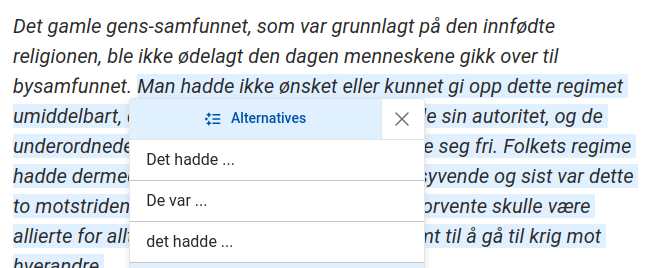
The translation might be faithful to the French form: in the active voice with the French (im)personal pronoun on translated by the Norwegian man.
Det gamle gens-regimet, som var tuftet på den hjemlige religionen, hadde ikke blitt ødelagt den dagen menneskene gikk over til byens regime. Man hadde ikke ønsket eller man hadde ikke kunnet gi det opp umiddelbart, lederne ønsket å beholde sin autoritet, de underordnede hadde ikke umiddelbart tanken om å frigjøre seg. Man hadde derfor forent gens-regimet med bystatens. Men i bunn og grunn var det to motstridende regimer, som man ikke burde håpe å kombinere for alltid og som før eller senere måtte gå til krig mot hverandre.
Or rewrite it all in the passive voice.
Det var ikke ønsket eller det var ikke mulig å umiddelbart gi det opp, da lederne ønsket å beholde sin autoritet, og de underordnede ikke umiddelbart tenkte på å frigjøre seg. Derfor hadde gens-regimet blitt forent med bystatens regime. Men i bunn og grunn var disse to regimene motstridende, som det ikke burde håpes å kunne kombinere for alltid, og som før eller senere måtte komme i konflikt med hverandre.
By way of conclusion, how to best practice the kind of translation exercise presented in what precedes? First, we may work out a personal Norwegian translation, no matter how lacking. Then, we may query a good web translator. Strive to understand the correspondences word group by word group. Return to grammar points if necessary. Evaluate for each word, each turn of phrase, possible alternatives.
With that, we may blind the Norwegian, stare at the English, grasp a blank page, a fountain pen, and strive to find the translation again. Not (entirely) from memory, but rebuilding piece by piece.
We shall proceed the same way sentence by sentence, erase, start again, at the end of a paragraph, repeat the full paragraph.
Go hiking in the forest, and on your return, start again.
Perhaps the most effective exercise.
Fustel de Coulanges, N. D. (1864). La cité antique. Durand.
Michelet, J. (1846). Le peuple. Hachette & Paulin.
Pustejovsky, J. (1998). The generative lexicon. MIT Press.
Andersen, Ø. (2007). Deverbal nouns, lexicalization and syntactic change. Nordic Journal of Linguistics, 30(1), 55–86. https://doi.org/10.1017/S0332586507001655
As said, this is a republishing of an older essay dated October 2023. That was, it seems, the time of our first attempts at Norwegian. Norwegian has since become pretty fluent, in reading, writing, and speaking. Viewed from a distance, the beginnings are inconceivable. We would like to ask our hesitant self: what is it that you don’t understand? It’s clear. At a certain point, the keys turn in the lock, and it’s hard to recall the fog in the mind of that past self who was left standing on the threshold, unable to imagine what the inside of the house looked like. A language is a house that we make our own and inhabit.
Fustel de Coulanges does not, a priori, have much to do with the Far North (at least, not with regard to this text on the ancient world). The convergence of these two worlds is simply a matter of the simultaneous existence, back in the day, of two interests: the Norwegian and this classic, which had arrived, who knows how, within our field of vision. The essay thus illustrates the possibility of proceeding with text exposure in the target language even when the occasion is in a familiar language. All that is needed is a reliable translator.
As a final comment from the time of our revision, which is also that of our learning Finnish like a machine, and looking back at the lexicalization of nouns derived from verbs, (some older) Finnish grammars deem the deverbal noun closest to its verbal origin (formed by appending the suffix -minen) to be (in some of its use cases) a 4th infinitive. As one, it partakes, or formerly partook, in conjunction with olla (to be), in the expression of a command or a prohibition: se on tekeminen, it must be done. The form’s lexical fixation in a few idioms (for example, sinne ei ole menemistä, one must not go there) further highlights the drift, from the verb, towards the lexicalization of the noun. A similar movement works across both languages, Norwegian and Finnish (as well as across many other languages), and there is no doubt that explicitly identifying it aids in the recognition of patterns, in the ease of navigating language. Two subsequent essays examine the grammaticalization of the future tense across several languages.